Impressionism was a group that got a bad nickname. Post-Impressionism was a nickname that got a group — and the difference explains why the second category has never quite held together.
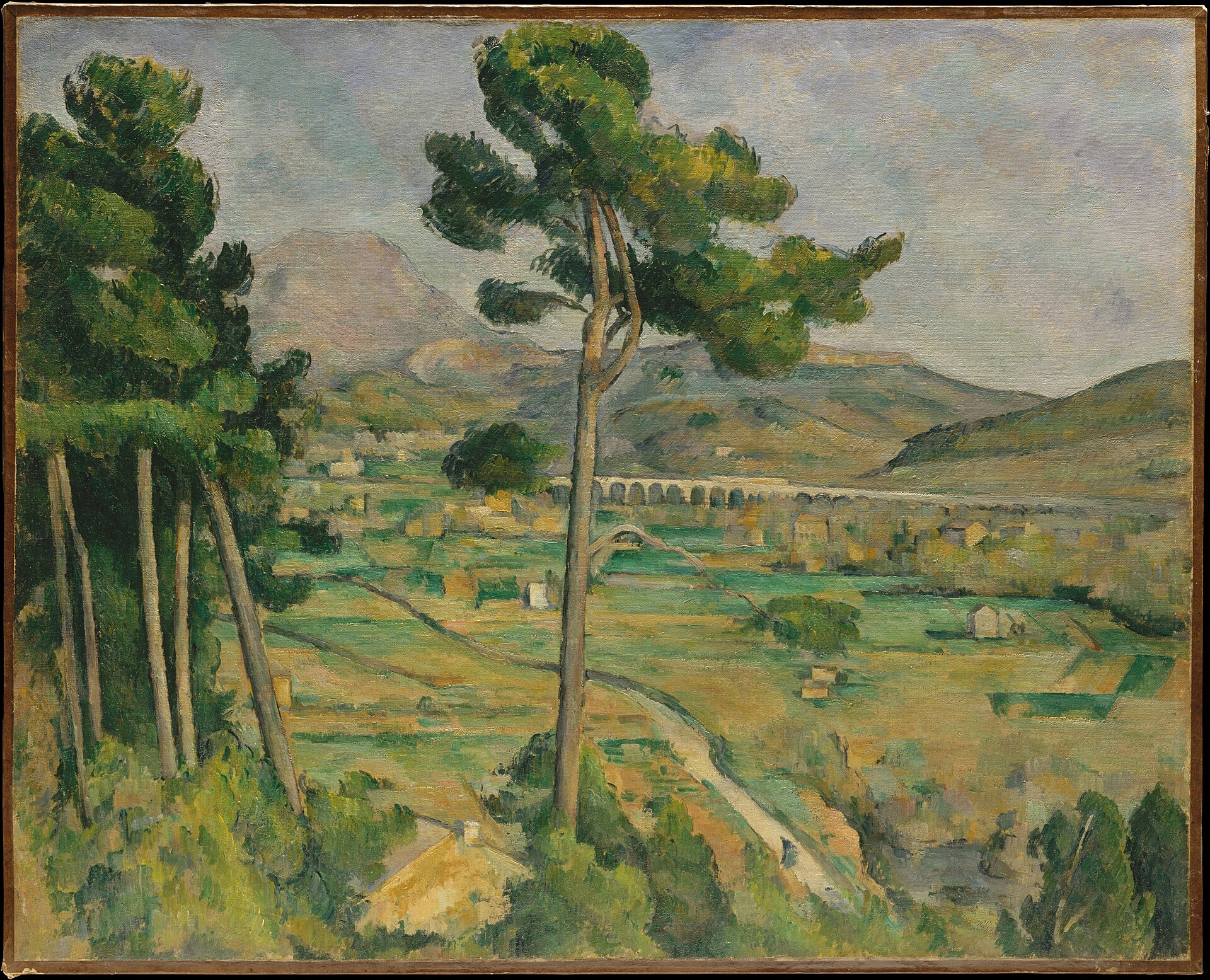
In Mont Sainte-Victoire and the Viaduct of the Arc River Valley (ca. 1882–85), oil on canvas, 65.4 × 81.6 cm, now in the Metropolitan Museum of Art, Paul Cézanne (1839–1906) builds a valley out of rectangles. The fields are laid in as flat patches of ochre and green, edged rather than blended. The viaduct’s arches repeat like a rhythm marked on a stave. The mountain behind is not atmospheric — it is drawn, with a contour you could trace.
Nothing here is dissolving. Whatever this is, it is not an attempt to catch the light at a particular hour before it moves.
The label arrives thirty years late
The word for what Cézanne was doing did not exist while he was doing it. It was coined in London, in 1910, by a critic organising an exhibition.
Roger Fry’s show Manet and the Post-Impressionists opened at the Grafton Galleries on 8 November 1910 and ran to 11 January 1911, drawing some 25,000 visitors. Fry and his collaborators needed a shorthand for the artists they were assembling, had none, and made one. The term appears in the catalogue introduction as a way of gathering a diverse group of exhibiting artists under a single word.
Consider who was in it. Cézanne had died in 1906. Vincent van Gogh had died in 1890, Georges Seurat in 1891, Paul Gauguin in 1903. The four painters most firmly attached to the term were all dead before the term existed. None of them signed a manifesto, shared a studio programme, or exhibited together under this name — because there was no name to exhibit under.

Compare how the other one got its name
Impressionism was also named by an outsider, and also as an insult. The critic Louis Leroy reviewed the first independent exhibition in Le Charivari on 25 April 1874, under the heading “The Exhibition of the Impressionists”, mocking Monet’s Impression, Sunrise in an invented dialogue — a preliminary drawing for a wallpaper pattern, one of his speakers complains, is more finished than this seascape.
The crucial difference is what the insult was aimed at. Leroy was reviewing a show the artists had organised themselves, having withdrawn from the Salon to do it. The group existed first. They had chosen each other, hung together, split the costs and taken the risk; there were eight such exhibitions between 1874 and 1886. Leroy gave a bad name to something that was already a thing.
Fry did the reverse. He gave a name to a set of pictures he had gathered, and the group came into being afterwards, retroactively, in the criticism.

The argument: the category is a container, not a movement
Look at what the four are actually doing and the container starts to strain.
Cézanne is after structure — the patch of colour as a building unit, the landscape reassembled as architecture, as the Mont Sainte-Victoire canvas shows in its edged fields and traceable contour. Seurat is after optical science, dividing colour into dots on a quasi-systematic method with its own name, Neo-Impressionism, and its own theorist in Paul Signac. Van Gogh is after pressure — paint as a record of the hand’s force, colour chosen for what it does to feeling rather than for what it reports. Gauguin is after symbol, flattening space and heightening colour to make pictures that mean rather than describe.
Structure, optics, pressure, symbol. These are four different answers, and at least two of them are incompatible: Seurat’s method is an attempt to make colour behave predictably, and Van Gogh’s is an attempt to make it behave expressively.
What unites them is negative. Each has stopped trying to do the thing Impressionism was doing. That is the whole of the shared content, and it is why the prefix is “post” — the category is defined by what its members came after, which is a confession that no one could find a positive definition. Note too that Fry’s title puts Manet first, a painter who had died in 1883 and who never exhibited with the Impressionists at all. Even the show’s own headline entity does not fit the category the show invented.

The case against this reading
Retroactive naming is normal and mostly harmless. Almost no movement names itself: Gothic, Baroque, Mannerism and Fauvism were all applied afterwards, several of them as abuse, and we do not throw the words out on that ground. Demanding that a period label describe a shared programme is holding art history to a standard it has never met anywhere else.
The stronger objection is that Fry saw something real. Beneath the four different methods there is a common turn away from optical description toward composition — a shared conviction that the painting is an object with its own order rather than a window reporting on a moment. That is a genuine art-historical observation, not a filing convenience, and the fact that it was noticed from London in 1910 rather than from Paris in 1885 does not make it false. Distance sometimes reveals the pattern.
Fairly stated, that is the better argument for keeping the term. It is worth noting that it also concedes the point being made here: what Fry identified was a shared direction of travel, not a movement, and the word we use implies the second.

What it changes
Practically, it changes what you expect from a room. Walk into an Impressionist gallery and the pictures will argue with each other about how to solve one problem. Walk into a Post-Impressionist gallery and they are not solving the same problem at all — a Seurat and a Van Gogh hung side by side have less in common than either has with painters from other rooms entirely.
It also suggests reading the label as a date rather than a description. “Post-Impressionist” tells you roughly when a painter was working and what they had already absorbed. It does not tell you what they were trying to do, and no single word could, because the four of them were trying to do four different things.
Leave a Reply