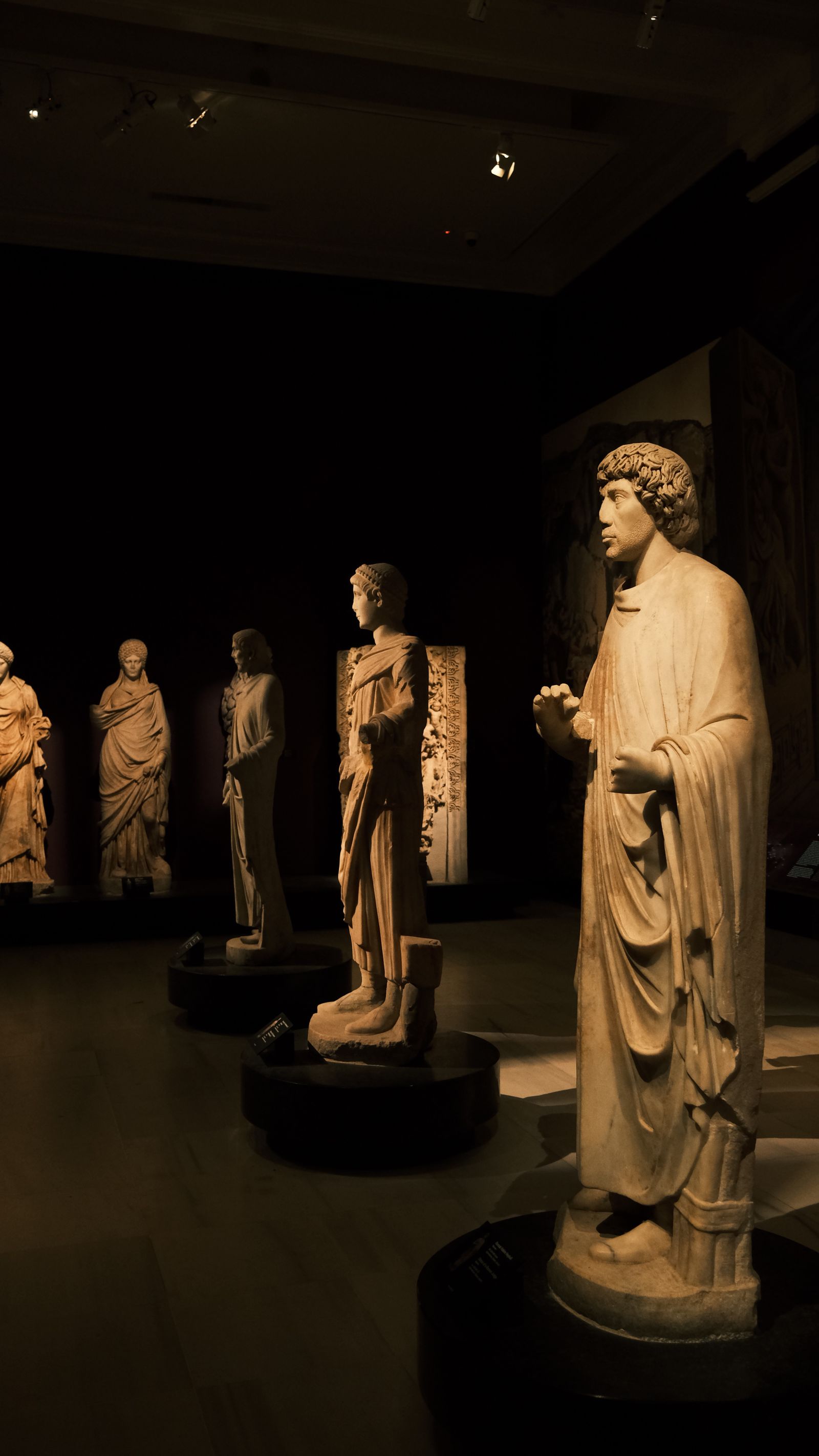
Ten Palaeolithic Venuses, every one a reproduction, and a steel sculpture that exists in five. An exhibition about enduring form with almost no originals in it.
Read the checklist for the Museum of Cycladic Art’s summer exhibition and one phrase keeps returning. Beside each of the ten prehistoric figurines, in the museum’s own wording: certified copy. Beside the Jeff Koons sculpture the show is named for, a different phrase, no less curious: One of five unique versions.
Neither is a slip. Both are accurate, both are standard, and the museum states them openly. But set them side by side and an exhibition that asks how meaning survives across forty thousand years turns out to be conducting that enquiry almost entirely through reproductions.
Jeff Koons: “Venus” Lespugue runs at the Stathatos Mansion until 31 August. It is curated by Dr Panagiotis P. Iossif and Dr Ioannis D. Fappas, and it pairs Koons’s Balloon Venus Lespugue (Orange) with ten figurines made across Eurasia between roughly 42,000 and 20,000 years ago.
What is actually in the room
The Koons is Balloon Venus Lespugue (Orange), 2013–2019: mirror-polished stainless steel with a transparent colour coating, 266.9 × 124.1 × 104.7 cm. It comes from the Homem Sonnabend Collection, the private holdings of Antonio Homem Sonnabend and Phokion Potamianos Homem, and Athens is its first public showing anywhere.
It belongs to Koons’s Antiquity series, begun in 2008, though he has said the Lespugue figure has interested him since the late 1970s.
The prehistoric works are a serious group. The Venus of Lespugue itself — mammoth ivory, about 28,000 years old, found in the Rideaux Cave in southern France — belongs to the Muséum national d’histoire naturelle in Paris. The Venus of Willendorf, roughly 29,500 years old, is in Vienna. The Venus of Savignano is in Rome, the two Venuses of Parabita in Taranto, the Venus of Dolní Věstonice in Brno, where it counts among the earliest ceramic sculptures anyone has found.
None of them travelled. The museum is direct about why: these are “certified copies of the immovable originals.”
The phrase that gives it away
“One of five unique versions” is not museum language. It is market language, and it is doing real work.
A unique object is one of one. An edition of five is five. The formula splits the difference — each cast differs, in Koons’s case by colour, so each can be called unique while the series supports five collectors instead of one. Everyone in the trade understands the convention and nobody is being deceived by it. But it is a manufactured scarcity, and it sits three metres from a set of objects whose singularity is not a construction at all. The Venus of Lespugue is one of one because a person carved it once, from a tusk, and no second attempt survived.
The exhibition puts a fabricated uniqueness beside an unrepeatable one and asks the visitor to consider material transformation. The comparison it invites is not quite the comparison it gets.
The mirror does the argument’s work
Koons’s surface is the detail that turns this from wordplay into something the object itself performs.
A mirror-polished sculpture does not present an image. It presents whatever is in front of it — the gallery, the other visitors, you. The one work in the show that is physically present rather than reproduced is also the one that most reliably fails to show you itself.
Meanwhile the ten copies do show you something: a shared visual language across thousands of kilometres and thousands of years — bulbous abdomens, pronounced hips, faces and limbs reduced almost to nothing. The curators put it precisely. “The body becomes the message,” they write; “its form, the vessel of meaning.”
The copies transmit the form. The original reflects the viewer. For an exhibition organised around what survives material change, that inversion is the most interesting thing on offer, and it is not in the wall text.
Where this reading is weakest
Three objections, and the third is the serious one.
First, certified copies are not a compromise, they are the only available practice. Palaeolithic figurines are fragile and legally immovable, and a museum that insisted on originals would simply not be able to mount this show — nor would anyone outside Paris and Vienna ever stand near a Venus of Lespugue. The Cycladic discloses the copies rather than obscuring them, which is the honest version of a constrained situation.
Second, editioning is ordinary. Reading “one of five unique versions” as a confession is reading a catalogue convention as a symptom.
Third, and hardest to dismiss: the exhibition never claimed to be about authenticity. Its stated questions are about the symbolic body, about whether a universal archetype of fertility persists, and about how material transformation alters or preserves meaning. Copies are the method, not the subject. An argument that the show is “really” about reproduction may be a writer’s thesis imposed on curators who were doing something else.
That objection is fair, and it does not quite dispose of the point. A show can be about one thing and demonstrate another. The Cycladic assembled a room in which the deep past arrives only as replica and the present arrives as a reflective surface — and then asked what survives material change. The exhibition answers its own question more sharply than it seems to intend.
What Koons says he is doing
Koons has been explicit about the lineage he sees, and it is worth quoting because it complicates the easy reading of him as a maker of expensive novelties.
“Of the four Balloon Venuses I have made, the Lespugue seems the most connected to the idea of modernism, as it brings historic forms from Paleolithic times into dialogue with the modernist movement. There are references to Giacometti and Brancusi sculptures, along with others. Even the Cycladic collection’s impact on modernism can be seen within the Balloon Venus’s silhouette and form.”
That last clause is a shrewd piece of siting. Cycladic figures shaped Brancusi and Modigliani; Brancusi’s abstraction shaped a century of sculpture; Koons is claiming a place at the end of that chain, in the one museum where the claim can be tested against the collection that started it.
Practical notes, and one disclosure
The show closes on 31 August 2026. Admission is €10, or €7 reduced; a combined ticket with the permanent collections is €16 or €10. There are Koons’s original sketches for the series, a museum-produced video of the artist, and a bilingual catalogue with essays by Koons and by researchers on Palaeolithic figurines.
Questions about what museums hold, and on what terms, are live in a sharper way this year: a new US law has stripped American institutions of the legal defences that used to defeat Nazi-era restitution claims, naming three of their courtroom victories in the statute itself.
One disclosure the museum makes and this article repeats: Gagosian, which represents Koons and has an Athens gallery, is a listed supporter of the exhibition. Commercial galleries routinely support museum shows of artists they represent, and there is no evidence of any influence on the curation. It is simply a fact a reader is entitled to have.
This article was written from the museum’s published checklist, images and statements rather than from a visit. On the question it raises, that seems close to appropriate: an argument about seeing prehistory at one remove, made at one remove.
More on this: France has since replaced the case-by-case approach outright. Law 2026-351 makes restitution routine — and decides, in one clause, who is allowed to ask.
Leave a Reply