The two names are confused because they rhyme. The two painters are confused because almost every account files them under one movement — and one of them never joined it.
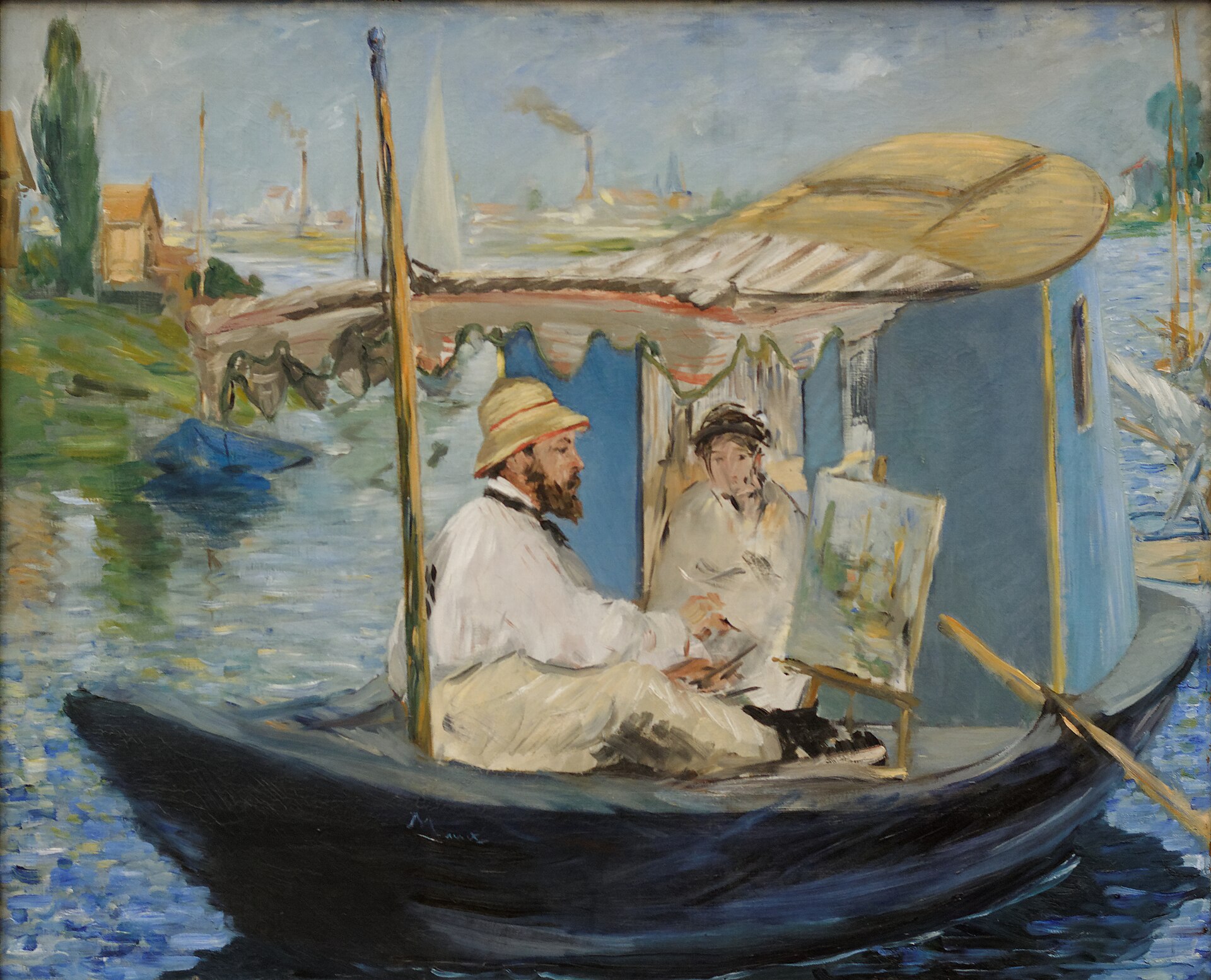
In the summer of 1874, at Gennevilliers on the Seine, Édouard Manet (1832–1883) painted Claude Monet (1840–1926) at work. The picture shows Monet inside a small covered boat he had fitted out as a floating studio, seated at his canvas, his wife nearby. It is an odd thing for one painter to do: to make a finished oil out of watching a colleague make a painting you cannot see.
Look at the hull. The dark band along the boat’s side, the shadowed interior of the cabin, the flat weight under the awning — Manet has used black, and used it structurally, to hold the whole composition together. In the same season, a few metres away, the man he was painting had all but stopped using it.
The confusion is older than the internet
It starts in 1865, when both men were hung at the same Salon. The exhibition was arranged alphabetically, which put Manet and Monet’s canvases near one another, and Monet’s two seascapes drew admiring notice. According to an account repeated by the Getty among others, Manet — the older, more notorious painter, and the one being congratulated for work he had not made — is said to have demanded to know who was pastiching his painting so basely. The remark is an anecdote rather than a document, and it should be read as one. The two men later became close.
What the anecdote preserves is a real problem that has never gone away. A century and a half later, the most common question asked about either painter is still which one is which.

One of them was never an Impressionist
Here is the fact that most short accounts skip. Between 1874 and 1886 the Impressionists mounted eight independent exhibitions, organised outside the official Salon system precisely because the Salon would not have them. Manet did not appear in a single one.
He was not excluded. He declined. Manet kept submitting to the official Salon — the institution the others had walked out of — and kept being accepted, exhibiting Argenteuil at the Salon of 1875, a painting often described as among his most overtly Impressionist works. He wanted the Salon’s wall, its jury, its audience, its scandal.
His route there ran through the Salon des Refusés of 1863, where Le Déjeuner sur l’herbe hung after the Salon jury rejected it — an exhibition of refusals authorised by the state, which is a very particular kind of outsider status. Manet’s whole career is spent hammering on the front door.
Monet’s begins by leaving through the back. Impression, Sunrise (1872) was shown at the first of the independent exhibitions in 1874, where the critic Louis Leroy saw it and published a satirical dialogue in Le Charivari on 25 April 1874 under the title “The Exhibition of the Impressionists”. He meant it as an insult — his imagined viewer complains that wallpaper preliminary sketches are more finished than this. The painters took the word and kept it.

The argument: they were not doing the same thing badly and well
The standard framing makes Manet the forerunner — the bridge from Realism into Impressionism, the older figure who cleared the ground. Read against his exhibition record, that framing looks less like art history than like tidying up.
The two projects point in opposite directions. Manet’s is institutional and confrontational: take the subjects the Salon considered unpaintable — a naked woman looking straight back at you, a picnic that refuses to be mythology — and force them onto the official wall in a technique that keeps the tradition’s authority. That is why the black stays. Black is the inheritance of Velázquez and Goya, the sign that this is serious painting making a serious claim, and it is what lets Manet’s pictures read as confrontations rather than as sketches. Remove the black and the confrontation loses its footing.
Monet’s project is not about the institution at all. It is about the fact that a haystack at eight in the morning is not the same object as a haystack at noon. That question does not need the Salon; it needs daylight, a lot of canvases, and a willingness to be outdoors. The Impressionist retreat from black follows directly — a shadow observed in daylight is not black, it is blue, violet, green. Removing black is not a stylistic preference. It is what the enquiry requires.
So the reading this piece proposes: Manet was completing something and Monet was beginning something else. Manet is the last painter who believed the Salon was worth conquering. Monet is among the first who found the question uninteresting. They overlap for one summer on a riverbank, and we have built a lineage out of the overlap.

The case against this reading
It can be pushed too far, and should be pushed back on. Manet’s palette genuinely did lighten at Argenteuil in 1874, under Monet’s direct influence and in his physical company — the studio-boat picture is evidence of the friendship, not of a standoff. Argenteuil is Impressionist enough that contemporaries said so. Influence ran in both directions, and a painter who refuses to join a group can still be changed by it.
A specialist could also fairly object that declining to exhibit was strategic rather than philosophical: Manet had spent a decade building a reputation through Salon scandal and had more to lose than a thirty-four-year-old with no market. That is a reasonable alternative explanation of the same fact, and it does not require any difference of project at all.

What it changes
Mostly, how you read a wall label. When a museum hangs Manet at the head of an Impressionist room, it is making an argument, not stating a fact — and the argument smooths over a choice Manet made repeatedly across twelve years and eight exhibitions.
It also gives you a faster test than the vowel. If the picture is built on black and looks like it is arguing with you, it is probably Manet. If the black has been evicted and the subject is dissolving into weather, it is probably Monet. That will not survive every edge case. It will get you further than remembering which one has the O.
Related: Post-Impressionism was invented in a London gallery in 1910.
Leave a Reply